Sometimes the most useful question isn't "why is this happening?" but "what would it look like if it weren't?"
Solution-focused therapy is built around that shift. Instead of mapping how a problem developed, it starts with where you want to be and works backward from there. It's a practical, future-oriented approach that respects your existing strengths and gets you moving quickly toward what you actually want.
What solution-focused therapy actually is
Developed in the 1980s by Steve de Shazer and Insoo Kim Berg, solution-focused therapy emerged from a simple observation: clients often made meaningful progress without ever fully analyzing the origins of their problems. What helped wasn't necessarily understanding why something was happening, but identifying what was already working and doing more of it.
So instead of asking "tell me about your childhood," solution-focused therapy asks questions like:
What would your life look like if this issue were solved?
When does the problem happen less often, or not at all?
What's one small step that would move you in the right direction this week?
The goal isn't to dismiss the past or pretend deep work doesn't matter. It's to recognize that for many concerns, you already have more resources and clarity than you realize. The therapist's job is to help you find them and put them to work.
The core ideas at the heart of solution-focused therapy
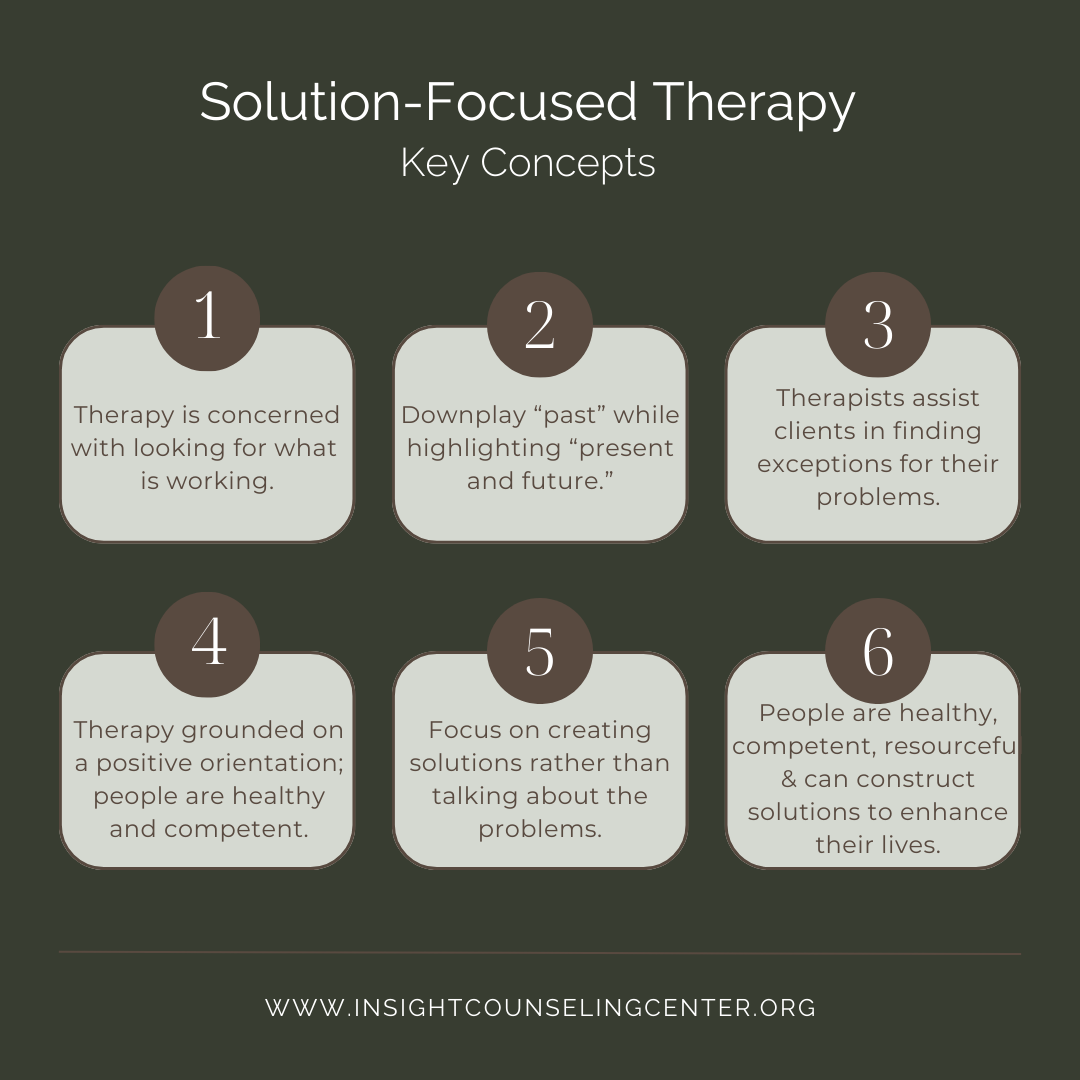
Solution-Focused Therapy Key Concepts
Future orientation. Rather than analyzing how the problem developed, sessions focus on where you want to go and what life looks like once you're there.
Exception spotting. Every problem has moments when it isn't happening, or when it's less intense. Those exceptions hold information about what's already working. The therapist helps you notice them and build on them.
Scaling questions. On a scale from 1 to 10, where are you with this issue today? What would a 7 look like? What's already getting you from 4 to 5? Scaling makes vague progress concrete.
The miracle question. If you woke up tomorrow and the problem were solved, what would be different? How would you know? This question helps clarify what success actually looks like in specific, observable terms.
Client expertise. You're treated as the expert on your own life. The therapist offers structure, questions, and reflection, but you know more about your situation, your values, and what works for you than anyone else.
What changes for people in solution-focused therapy
The shifts are pragmatic and often quick:
Faster traction. Solution-focused therapy is designed to be brief, often 5 to 10 sessions, with measurable progress along the way.
A clearer sense of direction. You leave with goals you can actually picture, not abstract intentions.
Stronger sense of agency. You stop waiting to fully understand the problem before taking action.
Recognition of existing strengths. The work makes visible the skills and resources you've been using all along.
Better goal-setting. Goals become specific, achievable, and tied to what matters to you.
Continuous course correction. Regular check-ins help you adjust as your situation evolves.
What solution-focused therapy works for
This approach is especially helpful for:
Specific issues with a clear goal in mind (job stress, conflict with a family member, a particular decision)
Life transitions where you need direction more than analysis
People who've already done insight work and want practical traction
Anyone who prefers active, collaborative therapy over open-ended exploration
Situations where time, energy, or budget make brief therapy a fit
It also works well alongside other approaches. Many clients use solution-focused techniques to make practical progress while doing deeper work in other areas.
Is solution-focused therapy right for you?
If you know roughly what you want and just need help getting there, solution-focused therapy may be the right fit. It doesn't ask you to spend months mapping your past or unpacking every nuance of how you got here. It asks where you want to be and helps you take real steps in that direction, starting now.
At Insight Counseling Center, solution-focused therapy is one of the evidence-based approaches we draw from based on what fits your situation. If you're curious about whether it might be the right starting point, schedule a free 15-minute consultation. We'll talk through what you're working with and figure out the best way forward.